
Contents
Everything, in order
Ten chapters and the bonus directory.
Sales & reseller edition / 2026
A 45-page field playbook: which businesses to walk into, what to say in the first twenty seconds, how to run the tap demo on someone else's counter, and exactly what to answer when the owner says it is too expensive.


The model
That is the whole reason this is worth learning to sell. The card is cheap to stock, takes twenty seconds to demonstrate, and fixes something a business owner already knows is broken — happy customers who never get round to leaving the review.
Goodword's live pack price.
One payment. No licence and no monthly fee attached to the card.
Goodword's own single-card price to a business.
The subtraction, before any of your own costs.
Figures are Goodword's live 10-pack and single-card prices, checked on 4 September 2026. The gross figure is a subtraction and nothing more: it excludes delivery, payment fees, advertising, travel and tax, and it assumes the card sells. You set your own prices, and what you earn depends entirely on how many businesses you actually visit.
Chapter 04, in full
This is the entire seven-step conversation from the guide, unedited. Hold this sequence and the same visit works in a salon, a workshop, a clinic or a takeaway.
“Quick one — are you the owner or manager? I help local businesses make it easier for customers to leave Google feedback. Can I show you in 20 seconds?”
“How do you ask for reviews now?” Then: “When do you ask?” and “How many tills, desks or handover points do you have?”
“So the customer usually has to remember later, search your name and find the review button. That's the part this removes.”
Tap the card with your own phone. Do not explain NFC first — let the notification and the page opening do the work.
“You leave this where customers pay. Staff say one sentence. The customer taps and decides whether they want to leave feedback.”
Count locations, not products. “You have four active payment points, so I would cover all four instead of moving one card around.”
Ask an operational question, not a buying one. “Black or white?” Or: “Do you want to start with one point, or cover the floor properly?”
The chapter around it adds the sixty-second version with timings, the do-and-do-not list that stops a demo turning into a lecture, the three-line answer for an owner who is too busy to talk, and the same-day follow-up message.
Look inside
Real pages from the guide. Drag or swipe to move through it.
Contents
Ten chapters and the bonus directory.

01
Why owners still lose reviews they have already earned.

02
Lead with the business leak, never with NFC.

03
Score a prospect before you spend an afternoon on it.

04
Permission, diagnose, demo, recommend, close.

05
Short messages that earn a reply instead of a block.

06
Fourteen objections with word-for-word answers.

07
Five closes built for local business owners.

08
Sell more cards without discounting blindly.

09
Ad hooks, follow-up and the monthly work that comes after.

10
What Google allows, and the 30-day sales sprint.

Bonus
Sourcing leads across eight countries.
Reference
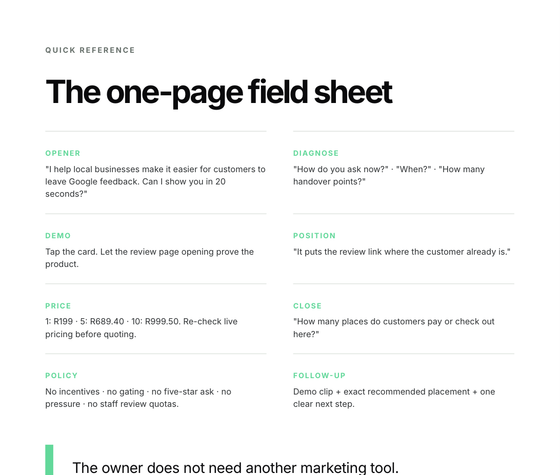
The whole system on a single page for your phone.
Page images are taken directly from the guide you receive.
The words
Walk-ins, direct messages, cold email and follow-up are all written out. These three are lifted straight from the guide.
Instagram / WhatsApp
The closing message, and why each one is answerable in a single sentence, are in chapter five.
Cold email
Two more cold emails and three follow-ups, including the break-up, are written out in full.
Follow-up
Plus the 24-hour bump and the 4-to-7-day placement follow-up.
Chapter 06
Not rebuttals to argue with. Each answer names what the owner is actually protecting — cash, risk or time — then puts one small question back to them.
Fair. I would not buy it as a gadget either. The reason businesses use it is that it sits at the customer handover point every day with no subscription to use it. If you only have one checkout, start with one card. If you have several points, we look at cost per placement instead. How many customer handover points do you actually have?
You can, and a QR code is useful. NFC is about reducing the interaction to a tap and giving you a permanent physical review point. If free QR is already working well for you, keep it. If the problem is that customers are not acting, the tap makes the handoff simpler.
The card is a shortcut to your review page, nothing more. Google allows businesses to remind customers and share a review link or QR code. The rules are about how you ask: no incentives, no selecting only the happy customers, no asking for a specific star rating, no pressure. We use it for genuine, voluntary feedback.
Also answered in full
The arithmetic
The pack prices below are Goodword's live prices, read from the shop as you load this page. Everything else is yours to set.
Before delivery, payment fees, advertising, travel and tax. This is arithmetic on the numbers you entered — not a forecast, not an average, and not a promise of income.
At that selling price you would lose money on every card.
Chapter eight goes further: how to build a wholesale floor from landed cost rather than guesswork, how much margin a reseller who prospects and travels actually needs, and why a bundle should make the decision simpler rather than just cheaper.
Fit
If either of the last two describes you, do not buy it. You will want a refund, and you will be right to.
Bonus chapter
A sourcing directory covering eight countries, with what each supplier is genuinely useful for. Contact details and the public pricing each one advertises are inside the guide.
Directory entries are sourcing leads, not endorsements or guarantees. Public pricing and terms were checked on 4 September 2026 and change without notice. Always request samples before committing to volume.

What this will not do
Make it easy to review. Never try to control the review.
A good deal of what is written online about review cards quietly teaches you to break Google's rules. This guide names the line and stays on the right side of it — partly because it is the law of the platform, and partly because a business whose profile gets restricted is not a customer you keep.
Ask broadly for genuine feedback and share a direct review link or QR code. Google permits both, and the guide shows you how to say so to a nervous owner.
You get the actual policy references, so when an owner asks whether this is allowed you answer with a citation instead of a guess.
Where the card goes, the one optional sentence staff can offer, and when to step away and leave the customer alone.
No money, discounts, free goods or services in exchange for a review. It gets reviews removed and can get a business profile restricted.
No selectively asking only the customers you expect to be positive, and no filtering negative feedback. The guide will not show you how, deliberately.
No asking for five stars, no dictating what a review says, no pressuring a customer on the premises, and no telling a business to set review targets for its staff.
Sources are cited in the guide: Google Business Profile Help on local ranking, getting more reviews, prohibited content and profile restrictions; BrightLocal's 2026 Local Consumer Review Survey; and Statcounter for South African search share. It is sales training, not legal advice.
What you get
Read it once on a laptop, then keep the field sheet on your phone for the actual visits.
The market, positioning, prospecting, in-person sales, direct messages, objections, closing, pricing, marketing and compliance.
Sent to the email address you check out with, as soon as payment clears. The guide itself is a PDF, so nothing ships for it.
Sourcing leads across eight countries, and the six things to check before you place a bulk order anywhere.
The opener, the diagnosis questions, the demo, the price line, the close and the policy rules on one page you can keep on your phone.
Choosing “Guide + demo card” adds one physical black NFC review card, dispatched within one working day of us receiving the link you want it to open. Delivery in South Africa is typically 5 to 7 working days after dispatch, and is calculated at checkout.
Stock
The demo is the pitch, so the one thing you genuinely cannot do without is a working card to tap. You are free to source anywhere — the directory covers eight countries — but this is the shortest route if you are in South Africa.
 NFC Review Card for Local Businesses
The card the whole guide is built around. Buy a pack, keep one to demonstrate with and sell the rest.
From R 199.00
 Custom NFC Google Review Card – Designed for Your Business
Branded with the business's own logo and colours. What you reach for with a franchise or a group.
R 400.00
 Instagram NFC Tap Card for Businesses – Grow Your Socials
Usually the easiest second sale. An owner who liked the review card tends to want one for their social profile too.
From R 199.00
Questions
A PDF download. The guide is not shipped. If you choose Guide + demo card, the card is a physical item and is dispatched within one working day.
No. The guide includes a supplier directory covering eight countries, and Goodword is one entry in it. Buying from Goodword is convenient if you are in South Africa; it is not a condition of using anything in the guide.
No. You need to be able to hold a phone near a card. The guide specifically tells you not to explain how NFC works during a demo, because it slows the conversation down and moves it away from the owner's actual problem.
Nobody can answer that honestly, and the guide does not try. It shows you what a card costs, what cards retail for, and how to work out your own margin. What you earn depends on how many businesses you visit and how many of them say yes.
One card to demonstrate with. At Goodword's current prices that is R199 for a single, or R99.95 a card if you buy a 10-pack. Chapter eight covers when holding stock makes sense and when it does not.
The sales process, the scripts and the objection answers are not country-specific. The pricing worked examples use South African rands and Goodword's live prices, and the supplier directory covers the United Kingdom, United States, Europe, Australia, New Zealand, India and Canada as well.
No. It is licensed for your own use. Using the scripts and the process in your own business, as much as you like, is exactly what it is for.
No. It is a sales process for a low-cost physical product, and it involves walking into businesses or sending messages and being told no fairly often. The guide says so on its second page, before you have read anything else.
Start
Happy customers, a Google profile where the reviews have gone quiet, and a counter with nothing on it. The difference is whether you know what to say in the first twenty seconds.